An engine failure on the motorway, a blown tyre on a country road or a minor collision in the middle of town: nobody is immune to trouble on the road. When it happens, knowing how to find a reliable towing service Tunisia drivers can count on saves precious time and helps you avoid costly mistakes. This guide walks you through what to do after a breakdown or accident, how a tow actually works, what affects waiting times, the safety rules to follow and how to get a tow truck quickly, day or night.
Breakdown or accident: the first things to do
Before you even think about calling a tow truck, your top priority is your own safety and that of your passengers. A stationary car on the road is a hazard for you and for other road users, especially at night, in the rain or on a fast road.
If your car breaks down
- Make yourself visible straight away: switch on your hazard lights at the first sign of trouble (warning light, unusual noise, loss of power).
- Pull over as far right as you can, onto the hard shoulder or a firm verge, avoiding bends and the tops of hills where other drivers can’t see you.
- Put on your high-visibility vest before getting out, and have passengers exit on the side away from traffic.
- Place your warning triangle far enough behind the car so approaching drivers have time to slow down.
- Get to a safe spot behind the safety barrier or well away from the road. Never stay inside the car, or stand in front of or behind it.
- Note your exact location: road name, direction, nearest exit or landmark, or better still, the GPS location from your phone.
If you’ve had an accident
If anyone is injured, call the emergency services immediately (civil protection, SAMU, police or national guard depending on where you are). Don’t move an injured person unless there is an immediate danger such as a risk of fire. After that, a few simple steps will protect you later on:
- Secure the area with your hazard lights, triangle and vest.
- Photograph the vehicles, their position on the road, the number plates and the damage before anything is moved.
- Fill in an accident report form (constat amiable) with the other driver if the situation allows, staying calm and sticking to the facts.
- Inform your insurer quickly and check whether your policy includes roadside assistance cover.
- Only have the vehicle moved once the formalities are complete, unless it is dangerously blocking traffic.
For official recommendations and news on road safety, you can visit the website of the Tunisian Ministry of the Interior.
On-the-spot repair or tow: how to know what you need
Not every breakdown requires a tow. Sometimes a quick roadside repair is enough to get you moving again. In other cases, trying to keep driving can turn a simple fix into a major repair. Here are a few pointers:
| Situation | Usually the right solution |
|---|---|
| Flat battery | On-the-spot help (jump-start with a booster or cables) |
| Puncture with a usable spare wheel | Wheel change on the spot |
| Out of fuel | On-the-spot help if possible |
| Engine won’t start for no obvious reason | Tow to a garage |
| Overheating, smoke, major oil or fluid leak | Tow: do not drive any further |
| Damaged or undrivable vehicle | Flatbed tow |
| Automatic, 4×4 or electric vehicle | Flatbed tow preferred |
| Lorry, bus, construction machinery | Heavy-duty tow truck or heavy transport |
If in doubt, describe the symptoms precisely to the professional you contact: warning lights, noises, smells, what happened just before. A precautionary tow is always better than making engine damage worse by trying to reach the garage on your own.
Towing service Tunisia: how it works in practice
The principle is simple: a professional with a suitable vehicle collects your car where it has stopped and takes it to the destination of your choice (garage, dealership, home, car park). Behind that simplicity, though, there are several types of equipment, each designed for specific situations.
The different types of tow trucks
- Flatbed tow truck: the whole vehicle is loaded onto a tilting or sliding platform. It’s the safest option for damaged cars, automatics, 4x4s, electric vehicles, lowered or high-value cars, because no wheel touches the ground during the journey.
- Wheel-lift tow truck: it lifts one axle while the other keeps rolling. More manoeuvrable in town, it suits certain vehicles over short distances, depending on the manufacturer’s recommendations.
- Tow truck with crane or winch: essential for pulling a vehicle out of a ditch, soft ground, a sloping verge or any hard-to-reach spot.
- Heavy-duty tow truck: built for lorries, buses, farm or construction machinery, with far greater lifting and pulling capacity.
The steps of a typical call-out
- The request: you give your location, the type of vehicle, the nature of the problem and where you want it taken.
- Quote and confirmation: you receive a proposal and approve the job knowing exactly what to expect.
- The driver arrives: they secure the area, assess the vehicle and choose the right loading method.
- Loading and securing: the vehicle is lifted and firmly strapped down, usually at the wheels, so it can’t move during the trip.
- Transport to the agreed destination.
- Handover: you check the vehicle’s condition, collect your keys if needed and sign the delivery note.
Mention right away if the destination might be closed (a garage in the evening, at the weekend or on a public holiday): you’ll need a backup plan, such as delivery to your home or a secure car park.
Waiting times: what to expect
It’s the question every stranded driver asks. There’s no single answer: how long a tow truck takes to arrive depends on several factors.
- Location: in big cities such as Tunis, Sfax or Sousse, there are usually more tow operators available than in rural, mountainous or southern areas. Finding a tow truck Tunis-side at rush hour is a different experience from finding one on a remote road in the south.
- Time and day: rush hour, night time, weekends, public holidays or iftar time during Ramadan can affect availability and travel times.
- The equipment needed: a heavy-duty or crane-equipped tow truck is less common than a standard flatbed.
- How precise your location is: a vague description costs the driver valuable minutes.
- Traffic and weather: congestion, heavy rain or sandstorms make journeys longer.
To get help as fast as possible, the best option is a 24/7 roadside assistance Tunisia service that can reach several operators at once, rather than calling tow companies one by one.
How to help the tow truck reach you faster
- Share your GPS location rather than a rough description.
- Keep your phone charged and stay reachable: the driver may need to call you to find you.
- Describe the vehicle from the start (make, model, colour, manual or automatic) and the situation (on the road, in a ditch, in an underground car park).
- Send a photo of the vehicle and its surroundings if you can.
What affects the cost of a tow
The cost of a towing service Tunisia drivers request is never fixed: it depends on the specific situation. Here are the main factors:
- Distance between the breakdown and the destination, as well as the distance the tow truck has to travel to reach you.
- Type of tow truck required: flatbed, wheel-lift, crane or heavy-duty.
- Weight and size of the vehicle: a city car, an SUV, a van and a lorry don’t need the same equipment.
- Timing: a call-out at night, at the weekend or on a public holiday may be calculated differently.
- Access: an underground car park, a narrow street, rough terrain or a car stuck in a ditch take more time and manoeuvring.
- Extra operations: winching, waiting on site, clearing the road after an accident.
The safest approach is to ask for a free quote before confirming the job, so you know exactly what to expect. Also check with your insurer whether your assistance cover pays for all or part of the tow.
Staying safe during the tow: what to check
Handing your car over to a stranger by the roadside can be stressful. A few simple precautions help you avoid unpleasant surprises:
- Check the driver’s identity and make sure the truck that turns up matches the one you were told about.
- Photograph your car from every angle before loading, so you can compare its condition on arrival.
- Remove your valuables and keep the documents you’ll need with you.
- Point out any special features: automatic gearbox, all-wheel drive, air suspension, hybrid or electric drive, alarm or keyless entry. These details determine how the car should be towed.
- Never stay inside a vehicle being towed. If you need to travel with your car, ask in advance whether you can ride in the tow truck’s cab and how many passengers it can take.
- Inspect the vehicle on arrival before signing the delivery note, and report any issue straight away.
For more practical road advice, browse the other guides on our blog.
Booking a tow truck with Damjen
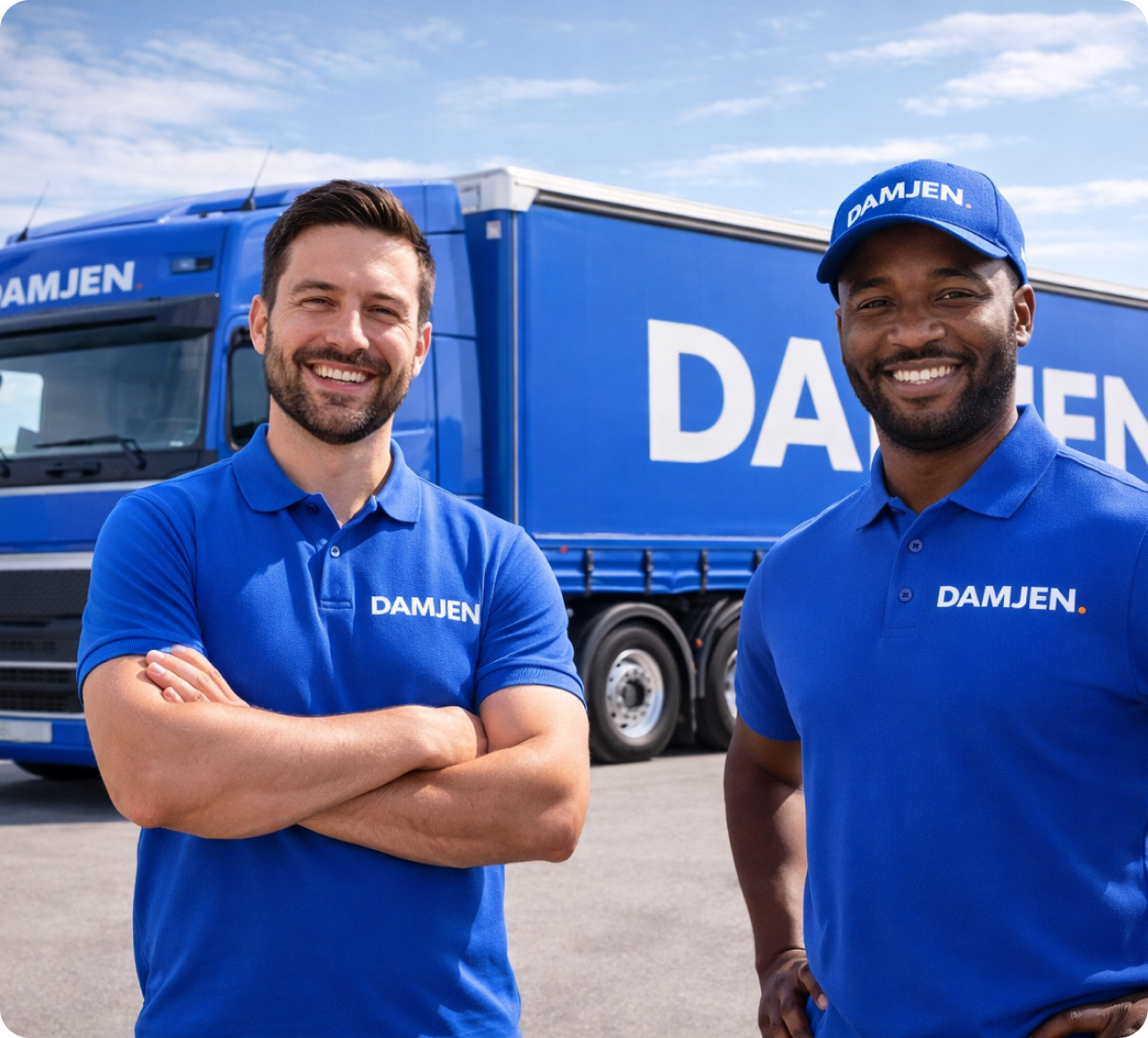
Damjen is a Tunisian platform that connects individuals and businesses with verified transport providers. Instead of searching for a random tow number in a panic, you can submit your request in moments from your smartphone:
- Open the app and choose the towing service.
- Enter your location (geolocation can be used) and your destination.
- Describe your vehicle and the problem: breakdown, accident, stuck vehicle, flatbed needed.
- Get a free quote and confirm the job.
- Track the provider on the way and stay reachable until your car is collected.
The service runs 24/7 and is designed for private motorists as well as companies managing a fleet of commercial vehicles. Beyond towing, the platform also covers goods transport, house moves and heavy transport: explore all our transport services.
Prevention first: be prepared before you set off
Good preparation reduces the risk of a breakdown and makes any call-out much simpler:
- Keep a full safety kit in the boot: vest, triangle, inflated spare wheel, jack, wheel brace, jump leads and a torch.
- Keep up with maintenance: oil change, fluid levels, tyres, battery and brakes, especially before a long trip or the summer heat.
- Check your insurance policy so you know exactly what your assistance cover includes.
- Install a towing app before you need it, so you don’t waste time on the day trouble strikes.
FAQ about towing service Tunisia
Can I get a tow truck at night or at the weekend?
Yes. Breakdowns don’t keep office hours, which is why a 24/7 assistance service matters. Availability can still vary by area and time, so the more precise your request, the faster you’ll be helped.
Will my insurance cover the tow?
It depends on your policy. Some include assistance cover, others don’t. Check your terms or contact your insurer before the call-out to find out what to do.
Can I choose the destination garage?
Yes, you’re free to choose: your usual mechanic, a dealership, your home or a car park. Just make sure the place will be open or accessible when the vehicle arrives.
Which tow truck for an automatic or electric car?
For these vehicles, a flatbed tow is generally recommended to avoid damaging the transmission. Check the manufacturer’s handbook and always mention it in your request.
Is a towing service Tunisia-based operators provide available for lorries and machinery?
Yes, as long as you use a heavy-duty tow truck or a heavy transport solution suited to the vehicle’s size and weight. Give these details when you make your request so the right equipment is sent.
Breakdown, accident or vehicle stuck? Don’t waste time hunting for a tow company: download the Damjen app from the App Store or Google Play, describe your situation and get a free quote from verified providers, 24/7. For any questions or business needs, contact our team.